

APC: Getting to Know their Human-Centered Approach to Communal Infrastructure
The Community Series features stories of the people and projects behind the digital rights community.
Since its foundation in 1990, the Association for Progressive Communications (APC) has brought together an extensive network of organizations working to advance digital inclusion, social justice, and digital rights. Together, APC and its active members spread across 62 countries, are using a human-centered approach to share knowledge resources, construct communal agendas, shape digital standards, and build a collective capacity of care. The core of their mission is to "strengthen collective organising” and create a future where digital technologies can enable social, environmental, and gender justice.
Team CommUNITY spoke with APC team members, igu absorty, hvale vale, and Shivi about APC’s human-centered approach to capacity building, what they’ve learned from the APC community, and how both an offline and online communal infrastructure fits into their vision of a more just Internet.

The History
The Association for Progressive Communications (APC) was founded in 1990 to support the coordination and development of an emerging global network of networks who were supporting movements, working on issues like human rights, peace and environmental sustainability, with digital communication tools. The seven founding organizations include NordNet (Sweden), Web (Canada), IBASE (Brazil), Nicarao (Nicaragua), and Pegsus (Australia). In 1995, APC received consultative (Category 1) status to the UN.
Today APC is a non-profit association of member and partner networks around the world, committed to making the internet serve the needs of global civil society. They focus on six key areas: human rights, Internet governance, feminist internet, digital inclusion, and environmental justice.
Communal Infrastructure Starts Offline
While Communal Internet Infrastructure can refer to hardware, software and specific services that are “designed, owned/co-owned, managed and operated by an organisation or community”, it is how they function in service of human “context, experiences, accessibility needs and knowledges” that is at the heart of the definition.
hvale was quick to point out that taking into account the offline infrastructure of care that is built around the use of these tools is just as important as the tools themselves when it comes to sustainable use and encouraging adoption:
“[I was doing a project…], we had partners and we needed to have conversations with them. We were using Mattermost, we had BBB [Bigbluebutton], we have always had NextCloud. So I created a team for my partners to join there. We created protocols to just agree about how to discuss. Email was for formal approvals. Conversations would happen in Mattermost. And we had this understanding of the time zone changes. It was agreed that no one should work outside of their working time. Our response time would work in two days.
All of these little things supported people to connect. This was beautiful because [...] one of the partners asked to have their own instance. At first we hosted, and then they created their own infrastructure, digitally. So, I think this was a small success.”
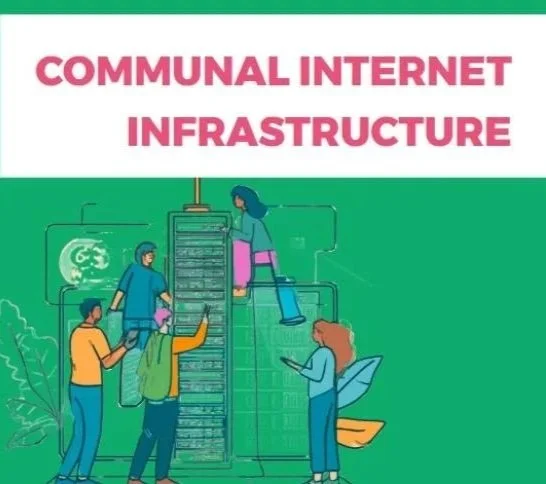
APC’s communal internet infrastructure paper serves a foundational guide for groups interested in creating alternative, self-managed digital spaces built upon the values of the community, autonomy and collaboration - while emphasizing democratic management, privacy and user rights.
These types of alternative, communal digital infrastructure empowers communities to take control of their digital lives.
Facilitator and Community Conveners Guide, They Do Not Dictate
Shivi also highlights that—especially in their work as facilitators and community conveners—their role is to guide, not to dictate.
APC approaches its work as a two-way process—learning from the community while also offering support. Shivi shares that setting up, maintaining, developing infrastructure requires a lot of work, time and skill. Most importantly, facilitators should contribute their skills and support without controlling or determining the direction of the process.
Like hvale, Shivi emphasizes how they learn from their community members, and how the tools being used should meet the needs and the pace of people at the center of that work:
“In our communications we learned about language justice, we had folks who were not comfortable with English. So we learned, how do we use emails and communications and translation? But even in that translation we were very careful about using open source sources. So, for example, if I’m writing an email to the team, I make sure that, at the top, I mention that there is a language translation below and this is the source we used to translate it. So we are also being careful with smaller things like that.
I remember that there were instances where, during meetings, sometimes people would use note taking bots during our calls. And those were tools that were already there. Now as human beings it is normal to go for the easier approach. It is easier [...] but especially in a vulnerable setting, where there are queer and trans folks, we have to be careful about privacy and security, so to navigate a situation like that where we gently explain how this can be a problematic situation, not just for us but for the community as well. Learning about how we can navigate, not by dictating but by bringing in our experience to support the community and to let them lead.”
Transitioning to an Communal Internet Infrastructure Requires Patience Not Perfection

Transitioning towards a communal internet infrastructure takes time and can also involve a learning curve. It is important to take into consideration the specific community’s technical capacity, their needs, and their resources when thinking about the sustainability of good communal infrastructure design.
As the authors of APC’s Communal Internet Infrastructure paper note, “there are hundreds of different ways to actually implement communal internet infrastructure concepts in the form of real world infrastructure. We must always remember that we are referring to infrastructure that is built for people and by people.”
hvale acknowledges that different communities are coming from different starting points and advocates patience.
“We know this is a privilege and an opportunity because APC owns an infrastructure. This [puts] us in a position that we can offer and share. But there is a learning curve. Inside APC, open source is the default, and anything that is not open-source is articulated, explained, understood, but also within staff there is complexity. I am using a machine to connect and to work, but I am using this machine, not just for my work with APC but also for other things [...] We need to be calm and wait for people to move in their own time and their own steps towards this.”
In the article, Infrastructures-done-differently, hvale highlights the importance of this transition period as a time to build the groundwork for a more sustainable change:

“As we transition from a practice where hardware is privately owned, deployed with little or no respect for the planet, and data is mined, collated, analyzed and algorithmized solely for profit, to a practice of infrastructures-done-differently, we can easily forget that humans need time. We forget that before the bloom, there is winter. The winter of infrastructures-done-differently is the seemingly unproductive abeyance of time, when people try, listen, learn, move in and out, get curious, then get comfortable and eventually achieve autonomy.”
To learn more about APC and their work around communal internet infrastructure, check out the following links: